WHY REPLACE MISSING TEETH?
Your teeth work together like a finely tuned machine, and losing even one tooth could be the start of serious problems if it isn’t replaced promptly. This booklet shows you what can be done to fill in the gaps in your smile.
BRAND – NEW
Tooth loss has many causes: decay, gum disease, and injuries are the most common. Missing teeth detract from your appearance and make eating and speaking more difficult, and the strain on your remaining teeth invites more tooth loss. The common options for preventing these problems are bridges, dentures, and implants.
EFFECTS OF TOOTH LOSS
Teeth shift so that the upper teeth no longer mesh with the lower ones. Chewing is difficult as well, and teeth may be sore.
Plaque builds up more easily as teeth crowd together, increasing the risk of decay and gum disease.
If back teeth are lost, lips and cheeks can sink into vacant spaces, making you look older.
Bridges are tooth replacements attached to adjoining natural teeth. They’re best for people with a few missing teeth.
The two most common kinds of bridge are fixed bridges and Maryland (bonded) bridges. Both require that the adjoining teeth be healthy and have good gum and root support. Bridges take two or three visits to put in place and can be removed only by your dentist.
• A fixed bridge consists of one or more artificial teeth set between crowns placed over adjoining natural teeth. The dentist shapes the natural teeth to receive the crowns.

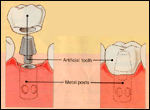
Implants, artificial tooth support surgically set in the jaw, can be used to replace any number of missing teeth. This procedure is best for adults who experience discomfort with conventional dentures but who have healthy gums, adequate bone to support the implant, and a commitment to oral hygiene.
Implants usually require outpatient or office surgery and take from three to nine months to complete.
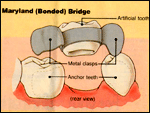
Maryland (Bonded) Bridge
• A Maryland (bonded) bridge consists of one or more artificial teeth between metal clasps. The anchor teeth are reshaped slightly, and the clasps are bonded to them.
• A metal post is surgically set in the jaw; an artificial tooth is attached to the post (above). If the jawbone has deteriorated, a metal frame may be fitted over the remaining bone to hold the posts.
A denture is a set of removable artificial teeth that rest directly o the gums.
Partial dentures are best for people with several teeth missing and whose adjoining teeth are too weak to hold a bridge.
Full dentures replace all the teeth on a jaw. They’re best for those who have lost all their upper or lower teeth because of such problems as decay or gum disease.
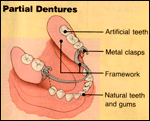
Partial Dentures
Partial dentures are artificial teeth attached to a framework Clasps fit onto adjoining natural teeth.
Full Dentures
Full dentures consist of a plastic framework (resembling natural gums) into which artificial teeth are set. The dentures fit directly on the gums.

Taking Care of Your New Teeth
- Brush and floss regularly. All tooth replacements are potential food and plaque traps, so good dental habits are more important than ever. Use a special toothbrush with a small, tapered head to reach hard-to-clean areas. Your dental professional can recommend one.
- Rinse your mouth with water after every meal, and if you wear dentures, rinse them out too. Rinsing will prevent food from getting trapped in or around your fixture.
- Ask your dentist or hygienist about alternatives to using floss if you can’t floss properly because of age or a handicap.
- Clean dentures thoroughly every night. Your dentist or hygienist can recommend a cleaning solution, but be sure to rinse it all off before putting the dentures back in your mouth or before storing them.
- Store dentures overnight in a moist denture box to keep them from drying and warping.
- Keep your mouth clean as well as your dentures. Brush your gums and the roof of your mouth with a soft brush (whose bristles can be further softened in a warm-water soak). You’ll clean away food particles and keep your gums healthy.