What you need to know about - Tooth Decay
Simple Answers To frequently Asked questions About Tooth Decay
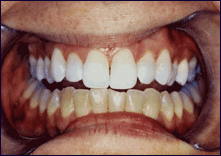
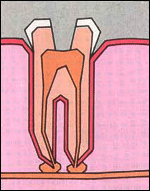
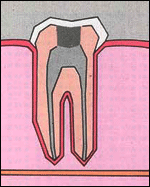
Tooth Decay describes the condition wherein the tooth, under a variety of harsh conditions, breaks down leading to the formation of a cavity. It starts with a hole/opening in the enamel. If this is not treated, it progressively reaches the deeper sections of the tooth, where the pulp and the nerves are causing the tooth to become sensitive to a variety of stimuli, a variety of gum problems such as inflammation and swelling, pain, and ultimately tooth loss.
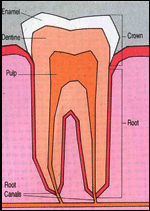
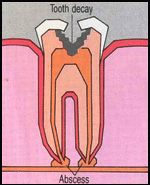
Tooth decay is a common dental ailment that may occur at any time or time or age. However, since the onset of tooth decay is strongly related to the unregulated consumption of sweet foods and beverages; it tends to affect the young and adolescents more than any other age. One form is diagnosed in nursing infants and is referred to as nursing caries.
WHAT IS ‘BABY BOTTLE TOOTH DECAY’?
A serious form of tooth decay affects nursing infants and is called ‘Nursing caries’ or ‘Baby bottle tooth decay’. In infants who are nursed continuously with a bottle/formula milk/ pacifiers; the milk is retained in the mouth as the child falls asleep with the bottle. This milk is an excellent nutritive media for a variety of gems present in the mouth. The milk is broken down by the germs to form harsh acids which lead to the formation of a cavity on the tooth.
1. POOR ORAL HYGIENE: Irregular & improper brushing, not flossing between teeth, not rinsing with water or mouthwash after meals speed up the process of tooth decay.
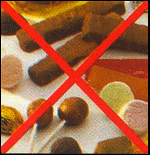
2. UNREGULATED DIET OF SWEET FOOD AND DRINKS: Periodic snacking on aerated drinks, jam, marmalade, even potato chips can lead to the formation of acidic by – products which damage the surface of the tooth enamel. This is the reason why most young children adolescents suffer from tooth decay.
3. BAD OR WORN OUT DENTAL FILLINGS: Tooth decay might develop again from exposed tooth surfaces.
If you have developed black or brown spots of decay on your teeth either in the fissures or on the smooth surfaces and it is associated with discomfort and /or sensitivity to hot and cold and / or frank pain, it is likely that you have tooth decay. Your dentist will evaluate you comprehensively and based on his clinical and radiographic findings he will do one of the following:
1. Make an opening in the crown and remove decay, shape the cavity and fill it with a tooth coloured filling or an amalgam filling. This could also be done under local anaesthesia.
2. If the dacay is very deep and the pulp (never, root canal) is involved in the decay process he will, under local anaesthesia go deeper into the pulp chamber, remove the pulp and the nerve, render it free of infection, do a root filling and later put an amalgam or a tooth coloured filling. Subsequently he will put a veneer or a crown on the tooth as the case may be.
PREVENTION IS THE BEST
CURE FOR TOOTH DECAY.
Certain Preventive measures are known to reduce the risk of tooth decay. You must practice these good dental habits:
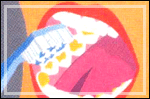
Brush your teeth twice a day. Hold a soft a brush at the gum line at a 45° angle. Brush in a circular motion to massage the gums and an up-down motion to dislodge plaque. Do this gently on the outer as well as inner surfaces of teeth.
Dentists recommend using a toothbrush with soft bristles and a small head. Replace your toothbrush every 3 months or as soon as it loses it’s original shape. Once a brush loses its shape, you require more pressure for the same cleaning action. This extra pressure is damaging to gums as well as the protective enamel layer.


Floss daily to remove plaque from between teeth. Take about 18” of floss and wrap most of it around your middle finger and the rest around the middle finger of the other hand, leaving a 2” length between them. Using your thumb and forefinger, gently scrape the side of each tooth away from the gum.
RINSE
Rinse your mouth with water thoroughly after each meal. Rinse for a minute everyday with mouthwash.
D I E T
Reducing the frequency of in take of sweets during the day, decreases the number of ‘acid attack’ by the digestive breakdown of these foods in the mouth. This prevents further damage to the tooth.
Expectant mother must be particularly careful with their diet and must make sure that it contains all the necessary nutrients and vitamins [described below] since the foundation of a child’s teething is laid early in the second trimester [3 to 6 moths]
A balanced diet that includes all food groups such as fresh fruits, vegetables, bread, cereals as well as other grain products, Dairy products such as milk, cheese, yogurt; meat, poultry, fish provides the essential nutrients required for dental growth.
1. Most effective method of preventing dental decay in general population is:
- Oral prophylaxis
- Fluorides
- Diet Counselling
- All of these
2. Regular visits to the dentist should be
Scheduled according to:- 6 Months interval
- Ages 3, 7, 10, and 13 years
- Patients need
- Annually.
3. Difference between a child’s toothbrush
And an adult’s is that the child’s toothbrush has- Smaller diameter bristles
- Softer Bristles
- An angled head
The Correct answers are
- Fluoride
- 6 months interval
- Smaller head size